
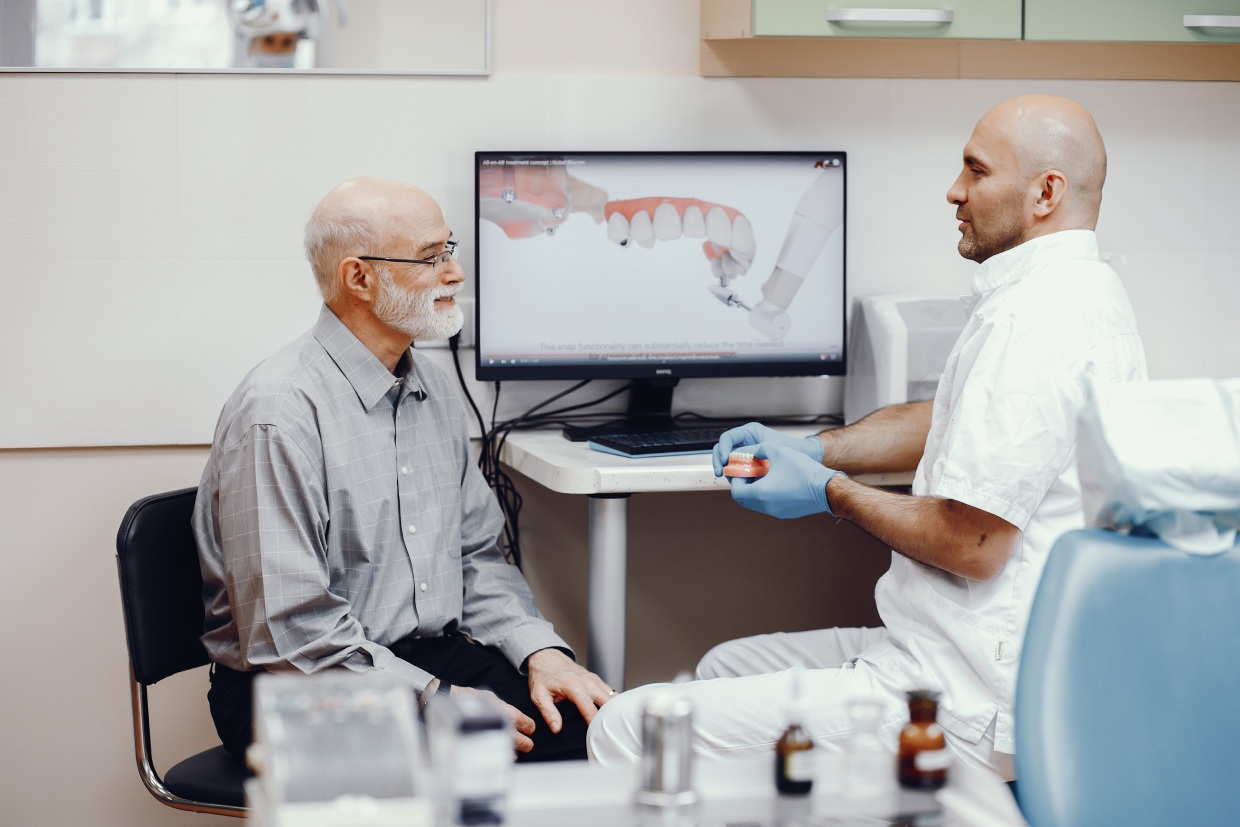
Few sentences shut a conversation down faster than “you don’t have enough bone for implants.” For a lot of people in Warner Robins, that one line ends the search for a permanent fix and sends them back to a denture they never wanted. It shouldn’t. Bone loss is a starting point for planning, not a permanent disqualification, and the way jawbone is measured and rebuilt today looks very different from the way it did ten years ago.
Here is what bone loss actually means, how it gets measured, and which tooth-replacement paths stay open when the jawbone has thinned.
Why the Jawbone Shrinks After Tooth Loss
A natural tooth root does more than hold a tooth in place. Every time you chew, the root transmits pressure into the jawbone, and that pressure is the signal the bone uses to keep rebuilding itself. Remove the root and the signal stops. The body treats that stretch of bone as surplus and gradually reabsorbs it.
The change is fastest in the first year after a tooth is lost and then continues slowly for as long as the space stays empty. Several other things speed it up:
- Untreated gum disease — advanced periodontal infection destroys the bone that anchors teeth, which is why bone loss and tooth loss so often arrive together.
- Years in a removable denture — a denture rests on top of the gums and never loads the bone, so the ridge underneath keeps flattening. That is also why a denture that fit well five years ago now slips.
- Long-standing infection or a failed root canal — chronic infection erodes bone around the root before the tooth is ever removed.
- Injury or a difficult extraction — trauma to the socket can leave less bone behind from day one.
This is also the mechanism behind the facial changes people notice years after tooth loss: as the ridge flattens, the lower face loses height and support. We covered that in more detail in our look at how missing teeth affect your face shape.
What “Not Enough Bone” Usually Means
An implant needs bone in three dimensions: enough height so the post has vertical support, enough width so bone surrounds it on all sides, and enough density so it holds firmly while healing. A site can pass on one measure and fail on another. Common situations include:
- A narrow ridge. There is height, but the ridge has thinned side to side and is too knife-edged to surround a post.
- Limited height in the upper back jaw. The sinus cavity sits directly above the upper molars and expands downward once those teeth are gone, leaving a thin shelf of bone.
- Limited height in the lower back jaw. The nerve that supplies the lower lip and chin runs through the lower jaw, and the implant has to stay clear of it.
- Soft or low-density bone. The volume is there, but the bone is not solid enough to stabilize a post immediately.
Each of those problems has a different answer. That is why a blanket “no” is rarely the end of the story — and why a second opinion built on current 3D imaging is worth getting.
How Bone Is Measured Before Implant Planning
A standard dental X-ray is a flat image. It can hint at bone loss, but it cannot show ridge width, true density, or exactly where the sinus and nerve sit. Planning an implant from a flat X-ray is guesswork, and guesswork is where a lot of premature “you’re not a candidate” verdicts come from.
Our office plans implant cases from cone beam CT imaging instead. A CBCT scan takes seconds, is painless, and produces a three-dimensional view of the jaw — bone height and width at each site, bone density, sinus position, nerve pathways, and any hidden infection. From that scan, the questions stop being abstract:
- How much usable bone exists at each intended implant site, in millimeters?
- Is there a site elsewhere in the arch with better bone that could carry the restoration?
- Would grafting be required, or could implant placement be angled to use the bone that is already there?
- Is active gum disease the real obstacle rather than the bone itself?
A patient who was told “no” on a flat X-ray sometimes turns out to be a straightforward case in three dimensions. The reverse happens too, and that is equally useful to know before treatment starts rather than after.
Rebuilding Bone: What Grafting Involves
When a site genuinely lacks volume, bone grafting is the standard way to rebuild it. Grafting places bone material into the deficient area and lets your body remodel it into your own bone over several months, creating a foundation an implant can hold.
Grafting is a category, not a single procedure. It ranges from a small amount of material placed into a socket at the time of an extraction — which preserves the ridge and often prevents the problem entirely — up to a sinus lift that restores height in the upper back jaw, or a ridge augmentation that rebuilds width. Scale drives the timeline: a socket graft may add a few months before implant placement, while a larger reconstruction takes longer.
Two points matter for planning. First, grafting is elective and it is staged — you will know the sequence and the cost before anything begins. Second, it is not always necessary, which is where the next option comes in.
Full-Arch Options That Work Around Bone Loss
If most or all of the teeth in an arch are gone, replacing them one at a time is not the goal anyway. Full-arch approaches are designed to concentrate support where the bone is strongest, which changes the math for patients with a resorbed ridge.
All-on-4 dental implants use four implants placed at angles that take advantage of the denser bone toward the front of the jaw, where resorption tends to be least severe. Because placement is angled rather than vertical, this approach can often avoid the grafting that a traditional implant plan would have required, and it supports a fixed arch of teeth rather than something removable.
Where the goal is stability at a lower cost than a fixed arch, implant-supported dentures anchor a denture to a small number of implants. The denture stops moving, chewing improves, and the implants continue to load the bone — which slows further shrinkage in a way a conventional denture cannot.
Both routes start from the same CBCT scan and the same question: where is the good bone, and what is the least invasive way to use it? You can compare the full range of tooth-replacement options across our restorative and implant services.
Health Factors That Matter More Than Bone Volume
Bone is usually solvable. The factors that more often decide whether implants succeed are about healing:
- Active gum disease should be treated first. Placing an implant into infected tissue puts the new implant at the same risk that took out the original tooth.
- Smoking restricts blood flow to healing tissue and is one of the clearest risk factors for implant failure. Stopping for the healing period materially improves the odds.
- Uncontrolled diabetes slows healing. Well-managed diabetes is a very different conversation from unmanaged diabetes.
- Certain medications, including some bone-density drugs and long-term steroids, affect how bone heals and need to be reviewed before surgery, not during it.
- Daily hygiene and follow-up visits. Implants do not decay, but the gum and bone around them can become infected. Long-term maintenance is what makes them last.
Bring your full medication list and medical history to the consultation. It changes the plan more often than the bone scan does.
Waiting Makes the Problem Harder
Bone loss does not plateau on its own. Every year an empty space stays empty, the ridge gets a little flatter, and the treatment needed to rebuild it gets larger. The same case that needs no graft this year can need one later.
If you have a tooth that is failing or an extraction scheduled, that is the moment to ask about preserving the site. If teeth have been missing for years and you have already been told implants are off the table, the useful next step is a 3D scan and a straight read of the numbers — not another flat X-ray.
Frequently Asked Questions
Can I get dental implants if I already have bone loss?
Often, yes. Bone loss changes how implants are planned rather than ruling them out. Depending on what a 3D scan shows, options include grafting to rebuild the site, angled placement that uses the denser bone already present, or a full-arch approach that concentrates support where the bone is strongest.
How do I know how much bone I actually have?
A cone beam CT scan measures bone height, width, and density in three dimensions and shows exactly where the sinus and nerve sit. A conventional flat X-ray cannot provide those measurements, which is why opinions based on one are worth re-checking.
Does bone grafting hurt?
Grafting is done with local anesthesia, and sedation options are available for patients who want them. Most people describe the recovery as similar to an extraction — soreness and swelling for a few days that is managed with prescribed or over-the-counter medication.
How long after bone grafting can implants be placed?
It depends on the size of the graft. Small socket grafts placed at the time of an extraction typically heal for a few months before implant placement, while larger reconstructions take longer. Your surgical plan will lay out the specific timeline before treatment begins.
Can All-on-4 implants avoid bone grafting?
Frequently. Because the four implants are angled to use the denser bone toward the front of the jaw, this approach can often proceed without the grafting a traditional plan would need. Whether it applies to your case depends on what the scan shows.
Will dentures stop my bone from shrinking?
A conventional denture rests on the gums and does not load the bone, so the ridge underneath continues to flatten — which is why long-term denture wearers need periodic relines. Implants transmit pressure into the bone and help preserve it.
Get a Straight Answer About Your Bone
Being told you are not a candidate for implants is not the same as being told why. If you are in Warner Robins, Bonaire, Kathleen, Centerville, Perry, or anywhere in Middle Georgia and you want the actual measurements behind that answer, we can scan the jaw, walk you through what is there, and lay out every option that fits — including the ones that do not require grafting.
Call or text (478) 929-2190, or request an appointment online, and we will get you scheduled for a consultation. If cost is part of the decision, our patient resources page covers financial and payment information.